


In this episode of The Safety Edge Podcast, we explore the hidden risk of untested expertise—and how confidence, when left unquestioned, can quietly shape decisions in high-risk environments.
Through a realistic operational scenario, we examine how teams can quickly align with experience, not because the thinking has been fully explored, but because no one pauses to test it.
We unpack how experience can create blind spots, how deference to authority can silence critical thinking, and how simple, intentional questions can surface risk before it escalates.
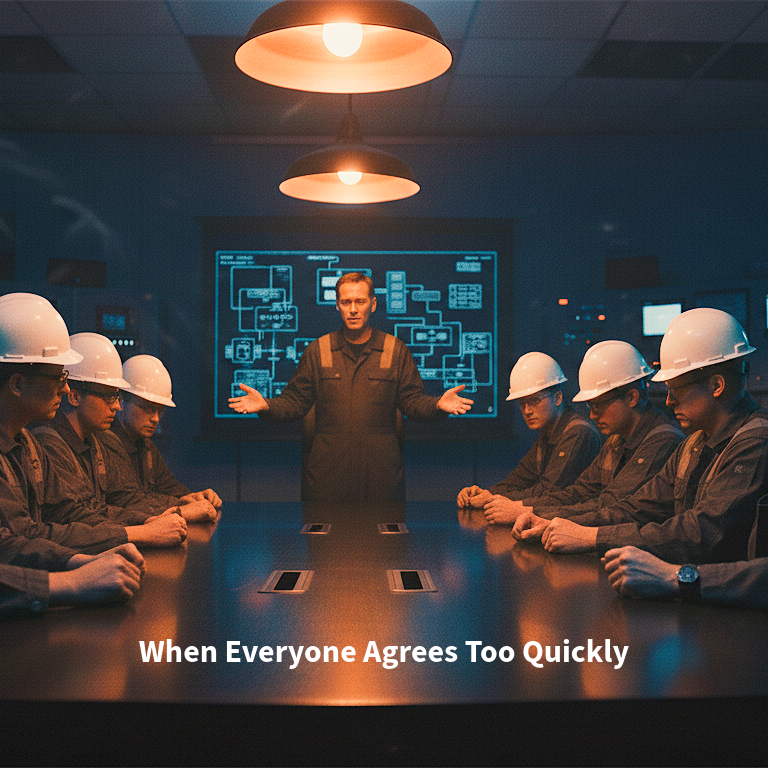
In this episode of The Safety Edge Podcast, we explore how agreement—often mistaken for alignment—can quietly erode critical thinking in high-risk operations.
Through a realistic operational scenario, we examine how experienced teams can default to consensus, not because they fully agree, but because no one challenges the room.
We unpack how dynamics like groupthink, authority bias, and social proof shape decisions—creating a false sense of certainty while risk remains unchallenged.
In this episode of The Safety Edge Podcast, we explore how familiarity—often mistaken for confidence—can quietly erode risk awareness in high-risk operations. Through a realistic operational scenario, we examine how experienced teams can stop seeing hazards that have become “normal,” and why small deviations often go unchallenged. Discover why traditional rules and audits aren’t enough, how curiosity and simple questions can restore awareness, and how safety leaders can create environments where risk is visible, understood, and actively managed.

In this episode of The Safety Edge Podcast, we explore how experience—often considered one of the greatest safeguards in high-risk operations—can sometimes become a hidden source of risk. Through a realistic operational scenario, we examine how familiarity, confidence, and the pressure to “get the job done” can quietly influence decision-making. Discover how experience can shape risk perception, why subtle signals are sometimes dismissed, and how safety leaders can build systems where discipline, not heroics, protects people and performance.
This episode explores the hidden risk not of individual effort itself, but of over reliance on it and how easily organizations begin to depend on people to compensate for system gaps.
We unpack:
Why repeated heroics often signal underlying system weakness
How strong individuals can mask risk rather than remove it
The difference between resilience and reliability
The role of leaders in identifying and closing system gaps
How small adjustments and workarounds become normalized
At the heart of it is a critical shift:
And in that moment, when a leader stops asking who fixed it and starts asking why it needed fixing, that is the edge.